Pereda Plurilingüe
en La Milagrosa
Un itinerario integrado de lenguas y cultura en Polanco, con la figura de José María de Pereda como hilo conductor.
De la digitalización al plurilingüismo
«Pereda Plurilingüe» da un paso adelante en la innovación del centro: lleva las lenguas a todas las áreas y une el aprendizaje del castellano, el inglés y el francés con la cultura y el patrimonio de nuestra tierra.
Tres lenguas
Castellano, inglés y francés conviven y se integran en las distintas áreas del currículo.
La lengua, vehículo
El alumnado aprende contenidos usando las lenguas en contextos reales y significativos.
José María de Pereda
Su vida y su obra unen lengua, literatura, arte y patrimonio de Polanco y Cantabria.
Conociendo a José María de Pereda
A lo largo del curso, cada trimestre integra una situación de aprendizaje evaluable en torno a un eje distinto.
La biografía
Quién fue Pereda: su vida, su tiempo y su tierra. Visita al CRIEME, mural en la Casa-Museo y escape room en la Biblioteca.
Pereda y Polanco
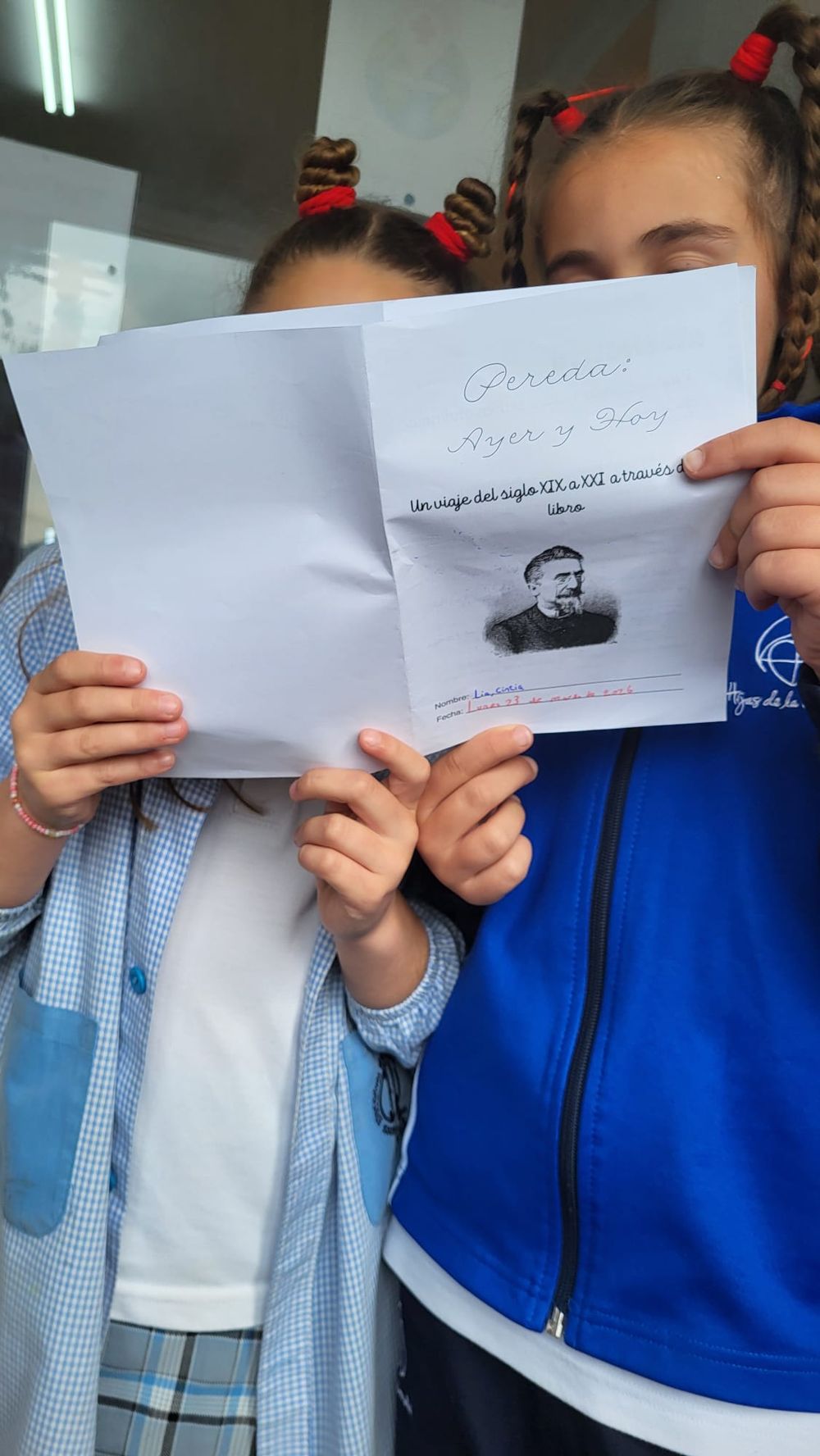
Los lugares del autor y la vida cotidiana de su época. Libro colectivo «ayer y hoy» y talleres peredianos.
Las obras
Sus historias, llevadas a la voz y a la escena: lectura dramatizada trilingüe y mapa cultural con códigos QR.
La vida de Pereda, contada por ellos
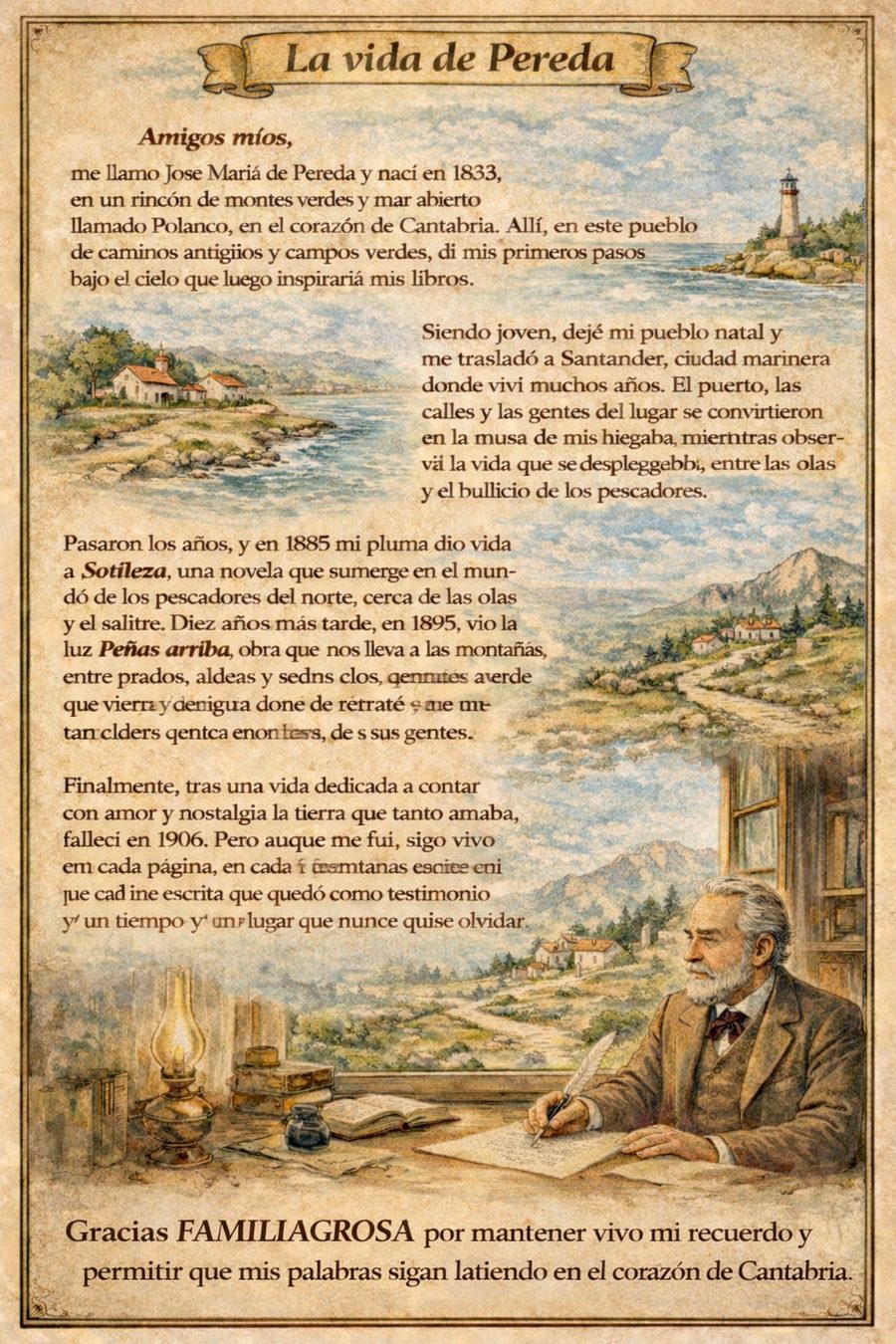
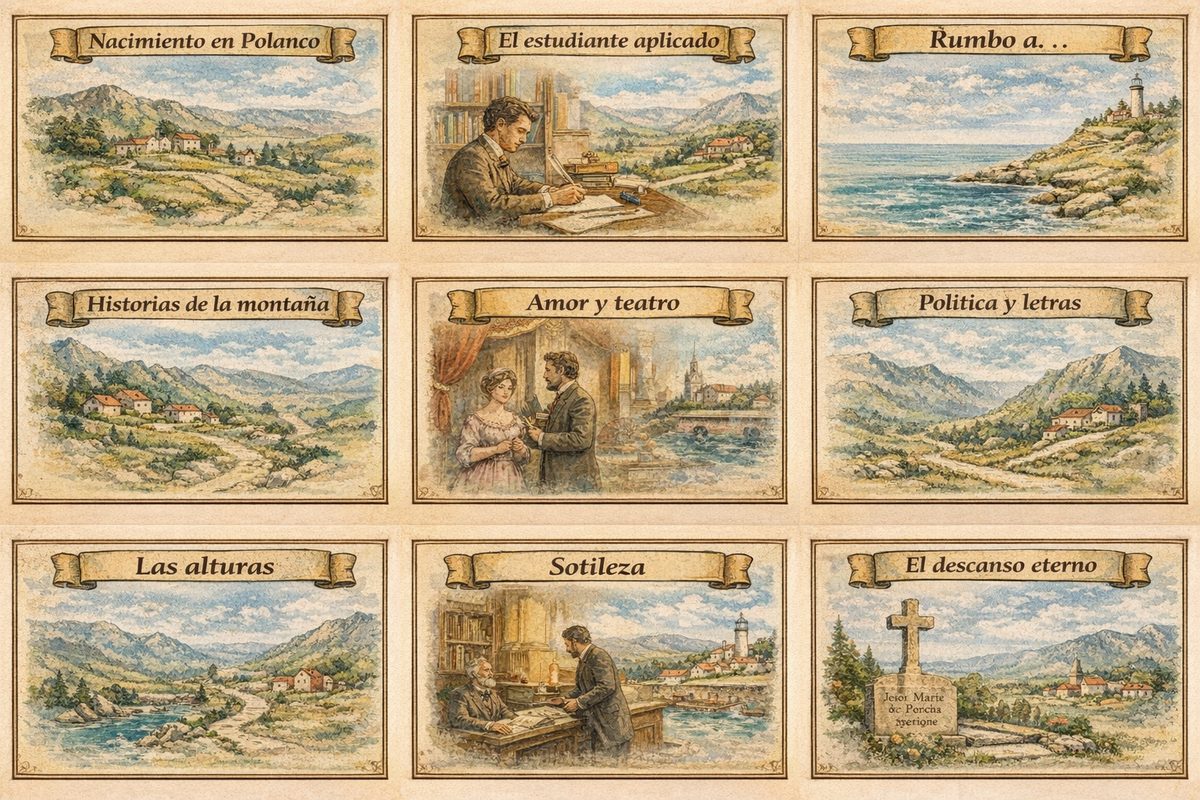
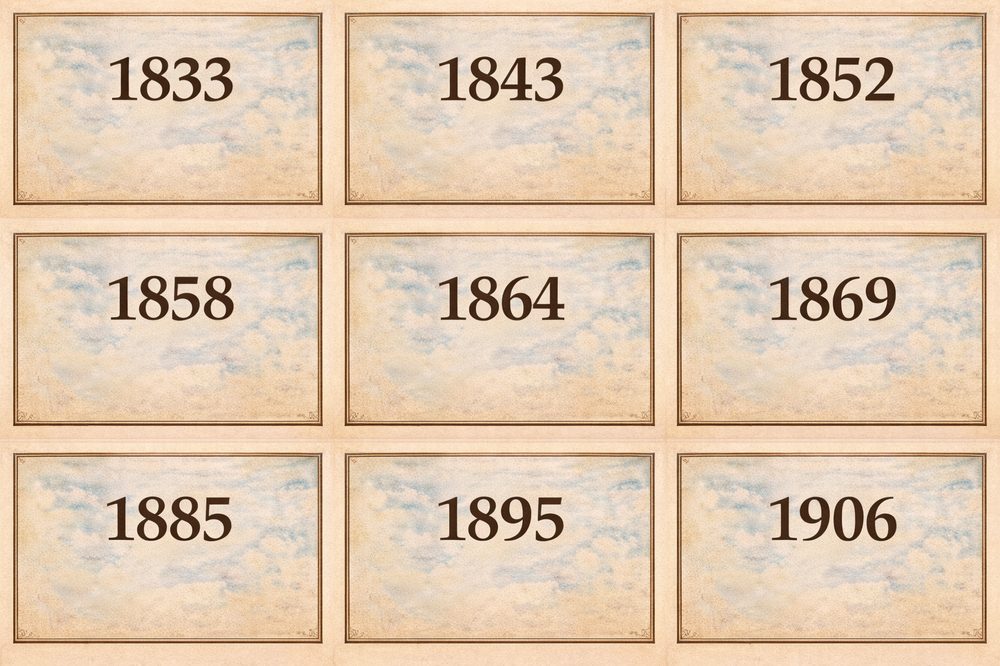
El alumnado investiga la biografía del autor y elabora láminas y líneas del tiempo que recorren los hitos de su vida, desde su nacimiento en Polanco (1833) hasta 1906.
- Textos biográficos y descriptivos en castellano.
- Traducción de la línea del tiempo al inglés.
- Vocabulario y juegos de lengua en francés.
El mapa peredano de Polanco
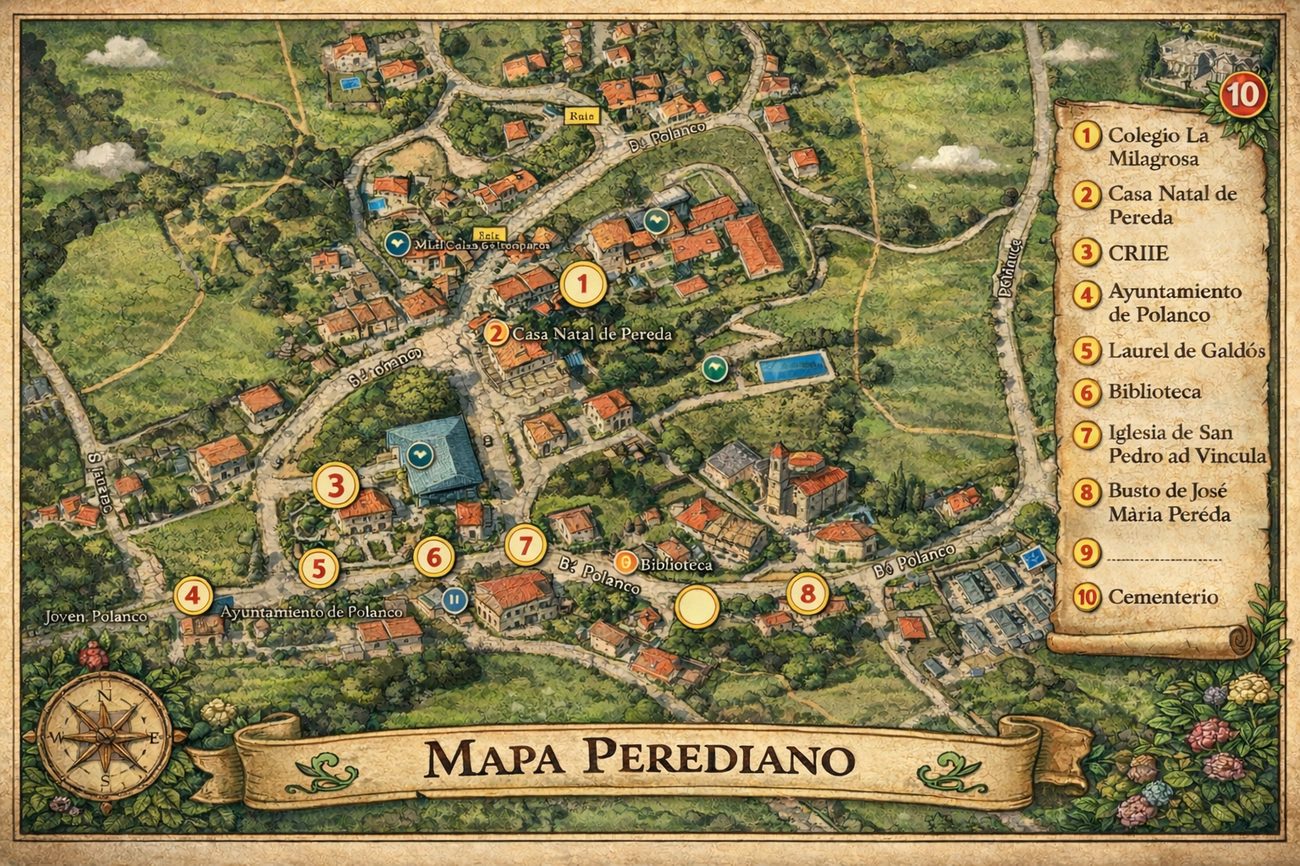
Un mapa que conecta el colegio con los lugares de Pereda: su casa natal, el CRIEME, la biblioteca, el busto del autor y más. Será la base de un itinerario trilingüe con códigos QR.
Pereda también en Matemáticas
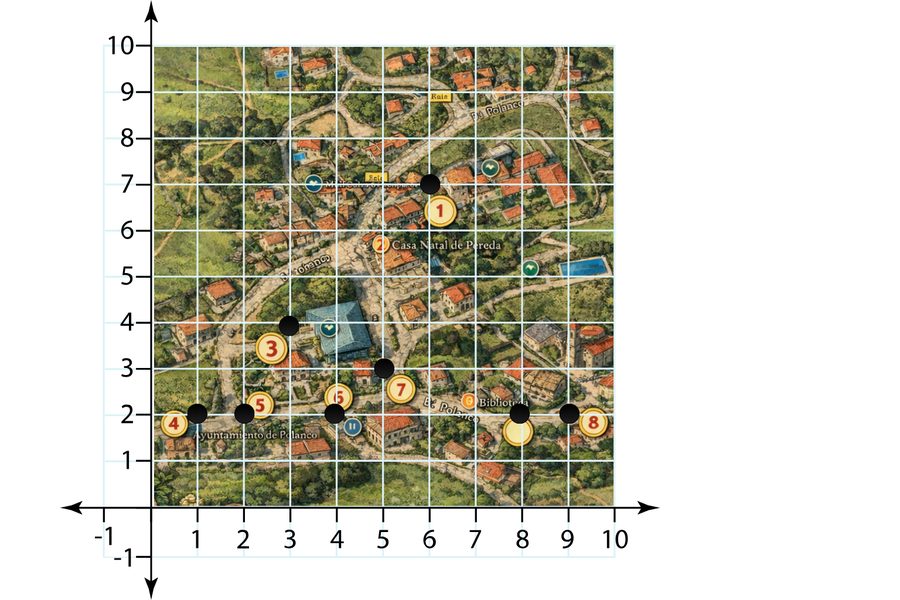
El proyecto llega a las áreas no lingüísticas: el alumnado localiza los puntos del mapa peredano sobre un plano de coordenadas, uniendo patrimonio, geografía y matemáticas.
Las tres lenguas en acción
Lengua vertebradora
Comprensión, biografía, descripción y diálogos sobre el autor y su obra.
Lengua vehicular
Vocabulario, líneas del tiempo y rutinas then / now en contextos reales.
Sensibilización
Vocabulario del paisaje y juegos de lengua que abren a una tercera lengua.
Productos del alumnado
Cada situación de aprendizaje culmina en un producto real y evaluable, parte de la programación de aula.
Patrimonio y comunidad
Casa-Museo de José María de Pereda
Lectura del paisaje y creación artística en el lugar del autor.
Biblioteca Municipal de Polanco
Escenario del escape room y del trabajo con la biografía.
CRIEME
Talleres vivenciales: escritura con pluma y juegos tradicionales.
Ayuntamiento de Polanco
Colaboración institucional y proyección del proyecto a la localidad.
Colegio La Milagrosa · Polanco (Cantabria) · Curso 2025-2026
Proyecto de Innovación Educativa plurianual 2025-2027.
Pereda Plurilingual
at La Milagrosa
An integrated language and culture pathway in Polanco, with the writer José María de Pereda as the connecting thread.
From digitalisation to plurilingualism
“Pereda Plurilingual” takes the school’s innovation a step further: it brings languages into every subject and links the learning of Spanish, English and French with the culture and heritage of our land.
Three languages
Spanish, English and French coexist and are integrated across the curriculum areas.
Language as a vehicle
Pupils learn content by using languages in real, meaningful contexts.
José María de Pereda
His life and work bring together language, literature, art and the heritage of Polanco and Cantabria.
Getting to know José María de Pereda
Throughout the year, each term builds an assessable learning situation around a different focus.
The biography
Who Pereda was: his life, his time and his land. Visit to CRIEME, a mural at the House-Museum and an escape room at the Library.
Pereda and Polanco
The author’s places and everyday life of his time. A collective “then and now” book and Pereda workshops.
The works
His stories brought to voice and stage: a trilingual dramatised reading and a cultural map with QR codes.
Pereda’s life, told by them
Pupils research the author’s biography and create posters and timelines tracing the milestones of his life, from his birth in Polanco (1833) to 1906.
- Biographical and descriptive texts in Spanish.
- Translation of the timeline into English.
- Vocabulary and language games in French.
The Pereda map of Polanco
A map linking the school to Pereda’s places: his birthplace, CRIEME, the library, the author’s bust and more. It will be the basis of a trilingual trail with QR codes.
Pereda in Maths too
The project reaches non-language subjects: pupils locate the points of the Pereda map on a coordinate grid, linking heritage, geography and mathematics.
The three languages in action
Backbone language
Comprehension, biography, description and dialogues about the author and his work.
Vehicular language
Vocabulary, timelines and then / now routines in real contexts.
First contact
Landscape vocabulary and language games that open the door to a third language.
Pupils’ products
Each learning situation leads to a real, assessable product, part of the classroom planning.
Heritage and community
José María de Pereda House-Museum
Reading the landscape and creating art in the author’s own place.
Polanco Public Library
Setting for the escape room and the biography work.
CRIEME
Hands-on workshops: writing with a quill and traditional games.
Polanco Town Council
Institutional support and outreach of the project to the town.
Colegio La Milagrosa · Polanco (Cantabria) · 2025-2026 school year
Multi-year Educational Innovation Project 2025-2027.
Pereda Plurilingue
à La Milagrosa
Un parcours intégré de langues et de culture à Polanco, avec l’écrivain José María de Pereda comme fil conducteur.
De la numérisation au plurilinguisme
« Pereda Plurilingue » fait avancer l’innovation de l’école : il introduit les langues dans toutes les matières et relie l’apprentissage de l’espagnol, de l’anglais et du français à la culture et au patrimoine de notre territoire.
Trois langues
L’espagnol, l’anglais et le français coexistent et s’intègrent dans les différentes matières.
La langue, un véhicule
Les élèves apprennent des contenus en utilisant les langues dans des contextes réels et significatifs.
José María de Pereda
Sa vie et son œuvre réunissent langue, littérature, art et patrimoine de Polanco et de Cantabrie.
À la découverte de José María de Pereda
Tout au long de l’année, chaque trimestre construit une situation d’apprentissage évaluable autour d’un axe différent.
La biographie
Qui était Pereda : sa vie, son époque et sa terre. Visite au CRIEME, fresque à la Maison-Musée et escape game à la Bibliothèque.
Pereda et Polanco
Les lieux de l’auteur et la vie quotidienne de son époque. Un livre collectif « hier et aujourd’hui » et des ateliers.
Les œuvres
Ses histoires portées à la voix et à la scène : une lecture théâtralisée trilingue et une carte culturelle avec des QR codes.
La vie de Pereda, racontée par eux
Les élèves recherchent la biographie de l’auteur et réalisent des affiches et des frises chronologiques retraçant les grandes étapes de sa vie, de sa naissance à Polanco (1833) jusqu’en 1906.
- Textes biographiques et descriptifs en espagnol.
- Traduction de la frise chronologique en anglais.
- Vocabulaire et jeux de langue en français.
La carte des lieux de Pereda à Polanco
Une carte qui relie l’école aux lieux de Pereda : sa maison natale, le CRIEME, la bibliothèque, le buste de l’auteur, etc. Elle servira de base à un parcours trilingue avec des QR codes.
Pereda aussi en mathématiques
Le projet touche aussi les matières non linguistiques : les élèves localisent les points de la carte de Pereda sur un plan de coordonnées, reliant patrimoine, géographie et mathématiques.
Les trois langues en action
Langue structurante
Compréhension, biographie, description et dialogues sur l’auteur et son œuvre.
Langue véhiculaire
Vocabulaire, frises chronologiques et routines then / now en contexte réel.
Sensibilisation
Vocabulaire du paysage et jeux de langue qui ouvrent à une troisième langue.
Productions des élèves
Chaque situation d’apprentissage aboutit à une production réelle et évaluable, intégrée à la programmation de classe.
Patrimoine et communauté
Maison-Musée de José María de Pereda
Lecture du paysage et création artistique sur les lieux de l’auteur.
Bibliothèque municipale de Polanco
Cadre de l’escape game et du travail sur la biographie.
CRIEME
Ateliers vivants : écriture à la plume et jeux traditionnels.
Mairie de Polanco
Soutien institutionnel et rayonnement du projet dans la commune.
Colegio La Milagrosa · Polanco (Cantabrie) · Année scolaire 2025-2026
Projet pluriannuel d’Innovation Éducative 2025-2027.
